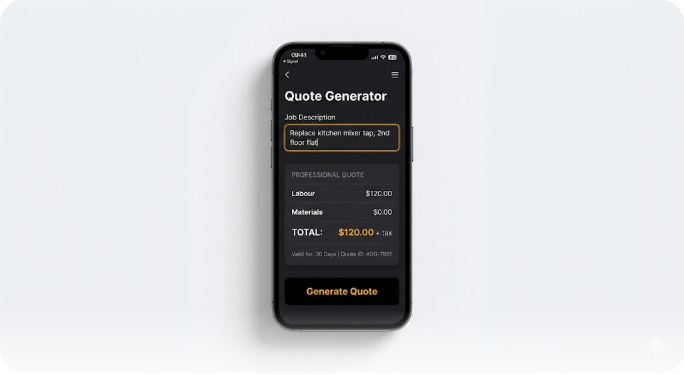
What Goes Into a Plumbing Quote
A quote isn't just a number. It's a breakdown that shows the customer what they're paying for, protects you legally, and sets expectations before work starts. A sloppy quote loses jobs to competitors who look more professional. A vague quote loses you money when scope creep hits.
Your quote needs three things: materials, labor, and your markup. Get any one wrong and you're either pricing yourself out or undercutting your profit.
Break Down Materials Accurately
Don't guess. Walk the job or ask detailed questions about what's actually needed.
- List every part: pipes, fittings, fixtures, sealant, flux, solder. Be specific with sizes and grades.
- Use your supplier's current prices, not what you remember from last month. Material costs shift fast.
- Add waste factor. Copper fittings get dropped. You'll cut wrong once or twice. Build in 5–10% extra depending on the job type.
- Call it out separately. Customers understand "materials: $450" better than hiding it in a lump sum.
If you're not sure what you'll need until you start, say so. Quote for a site visit or inspection, then follow up with a full material quote. It's better than guessing and eating the cost later.
Calculate Labor Time Realistically
This is where most plumbers leave money on the table. You know roughly how long a job takes—a simple tap swap, a new boiler install, a bathroom refit. But you're not pricing your time at what it's actually worth.
Start with your hourly rate. If you're not sure what that should be, work backwards: what annual income do you need, how many billable hours per year, what's your overhead? That gives you a real number, not a guess.
Then estimate hours honestly. New boiler install? Three hours minimum for a straightforward swap. Rough-in for a new bathroom? Full day. Running 40 meters of pipework under a suspended floor? You know it's not quick.
Add contingency. Not padding—real time for things that always happen: waiting for parts, finding unexpected damage, fittings that need adjusting. A quarter to a third extra time on complex jobs isn't greed, it's reality.
Factor in Call-Out Fees and Minimums
Not every job is worth your time at standard rates. A 15-minute emergency call-out at midnight isn't the same as a scheduled appointment during business hours.
- Set a minimum charge. Whether it's a 30-minute or 1-hour job, your time and travel are worth money.
- Add call-out fees for emergencies or work outside your normal hours.
- Charge separately for site visits if you need to assess before quoting the full job.
- Travel time. If the customer's 20 miles away, that's cost and time you need to recover.
Put these in your quote clearly. Customers will grumble about them anyway, but they're less likely to bail if they see them upfront instead of being surprised on the invoice.
Know What to Include and What to Exclude
Vague quotes create disputes. Be explicit.
Say what's included: your labor, materials, basic disposal of old fixtures, testing and commissioning. Say what's not: scaffolding hire, specialist equipment rental, building control sign-off, asbestos removal, replastering walls after you've cut them open.
If the customer needs something outside the quote—they want the old copper recycled separately, they want you to tie in extra pipes you didn't budget for—that's a change order, not your problem if you priced it differently.
Include a line like "Any work outside this scope will be quoted separately" or "Prices valid for 7 days" or "Payment on completion." Protects both of you.
Format It Professionally
Your quote is a sales document and a legal document. It should look like both.
- Use a template with your company name, logo, and contact details at the top.
- Date it. Reference the job address clearly so there's no confusion later.
- Itemize everything. Don't just write "bathroom work: £1,200."
- Include terms: payment method, when payment's due, how long the quote's valid.
- Add your VAT number if you're registered.
A typed quote on headed paper beats scribbled notes on the back of an invoice. It makes you look like someone who knows what they're doing—which you do.
Flint handles quote writing and job estimates for plumbers and electricians in seconds — try it free at ask-flint.com.